From Napoleonic Threat to Seaside Landmark
Eastbourne Redoubt has guarded the town's seafront for over two centuries, transforming from a fearsome coastal defence to a beloved family attraction and now a monument seeking renewed purpose.
The decision to build the fortress came at a conference in Rochester on 21 October 1804, with Prime Minister William Pitt the Younger in attendance. The scheme was devised by Captain William Henry Ford of the Royal Engineers and championed by Brigadier-General William Twiss, who commanded the Royal Engineer Southern District. Construction began on 16 April 1805 under contractor William Hobson.
An Engineering Marvel of its Age
The redoubt was constructed as one of three "circular forts" intended to support a chain of Martello towers along the south coast. The other two were at Dymchurch and Harwich. Whilst 74 Martello towers were ultimately built, only the three larger redoubts were completed; the planned redoubt at Rye Harbour was abandoned.
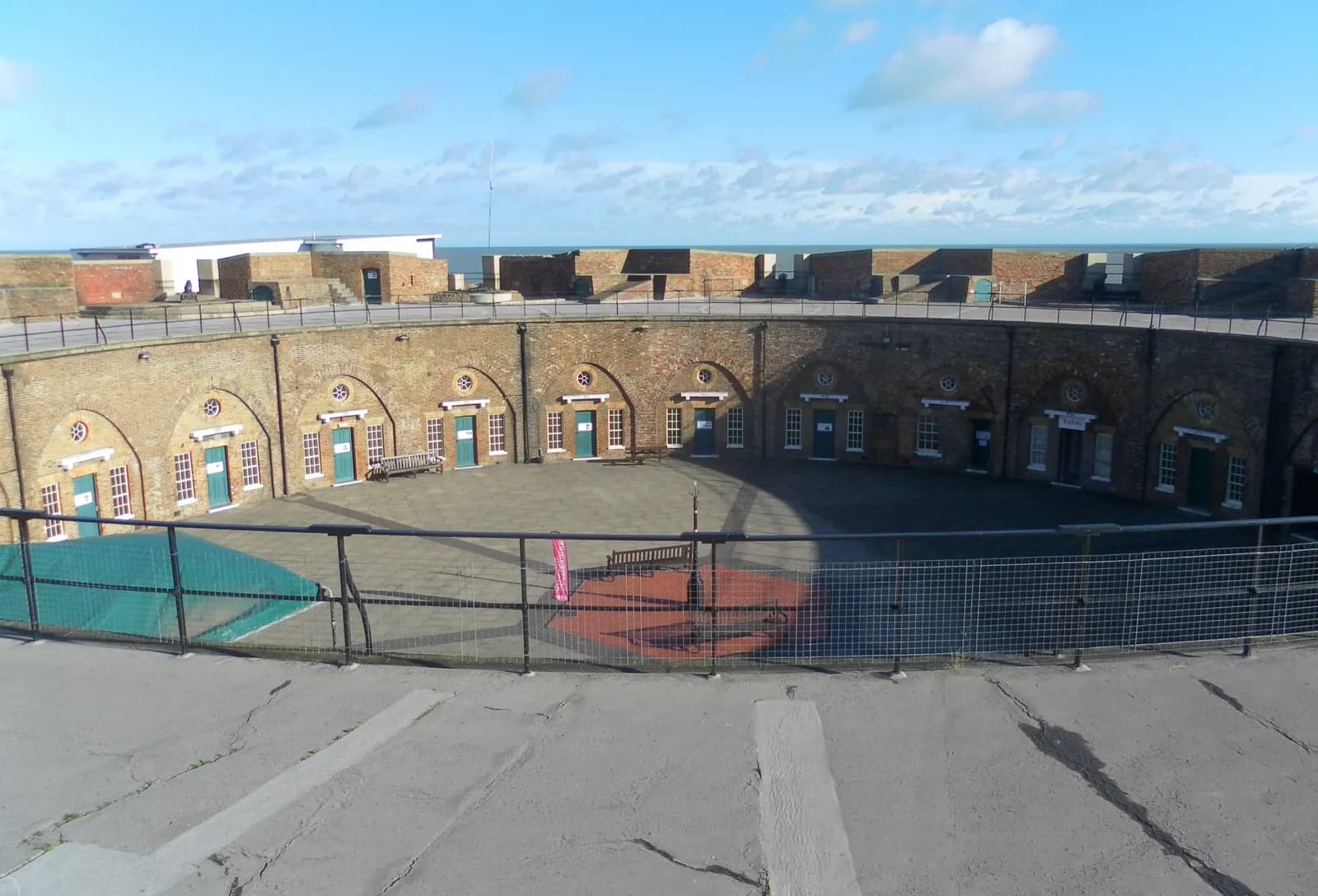
The structure measures 224 feet (68 metres) in diameter and is built almost entirely of brick with some granite facing. Five million bricks were transported by barge from London for the construction, with over 50,000 bricks used in a single course. The fortress sits on a raft of compacted chalk on natural shingle.
Its lower tier contains a ring of 24 casemates; vaulted chambers opening into a central parade ground. Casemate 11 served as the main magazine, whilst Casemate 8 was modified in the 1870s as a cook house. Casemates 23 and 24 were altered in the 1880s to create a detention room and two cells. The upper tier forms a terreplein, or gun platform, with a tall parapet pierced by granite-faced embrasures that originally held 11 guns.
Unique to Eastbourne Redoubt are five caponiers; covered galleries with loopholes that traverse the ditch floor. These were added in the mid-19th century. The structure was surrounded by a dry moat 25 feet (7 metres) wide and 30 feet deep, with a glacis, or earth ramp, on the far side. The seaward glacis was removed in 1890 during the construction of the sea wall and promenade.
Armament and Military Service
The redoubt was initially armed with 24-pounder guns on traversing carriages, though these were soon replaced by 36-pounder guns. By 1853, these had been replaced by 68-pounder smoothbore guns. The armament continued to evolve; by 1873, the fortress held four 8-inch rifled muzzle loaders, three 110-pounder rifled breech loaders, and two older 68-pounders. Expense magazines were added beside each gun position in the mid-19th century.
The fortress was designed to accommodate 350 men, though it is unlikely more than 200 could actually be housed at any one time.
The guns were fired in anger only once, in 1812, when two shots were fired at a passing French warship. Both missed. By the 1830s, the garrison had been reduced to just seven gunners, a gate keeper, and their families; the redoubt's main role had become that of barracks.
The 1859 Royal Commission on Defence of the United Kingdom, established by Lord Palmerston, reported that redoubts and Martello towers were "not an important element of security against attack."
During the First World War, the redoubt was used by the Royal Military Police as a headquarters and temporary gaol. In the Second World War, the Army requisitioned the building for storage and sold the remaining artillery for scrap. In 1944, anti-aircraft guns were mounted on the gun platforms to defend against passing V-1 flying bombs.
The Model Village Era
Following the First World War, Eastbourne Borough Council purchased the redoubt for £150 with the intention of creating a leisure venue. In 1934, a new bandstand was constructed in the gardens west of the fortress, and a colonnade was built over part of the moat.
In 1957, the redoubt was leased to entrepreneur Benjamin White, who created a model village on the parade ground. He constructed a new entrance from the moat with a staircase from the promenade, and the bandstand colonnade was converted into the Blue Grotto Aquarium, which operated until 1996.
The model village remained a popular attraction from 1957 until 1975, when it was vandalised and subsequently removed. By 1977, the redoubt had found a new purpose housing regimental museums.
Current Status and Future Prospects
Today, the Eastbourne Redoubt houses the regimental museums of the Queen's Royal Irish Hussars and the Royal Sussex Regiment, plus the Sussex Combined Services military collection.
The fortress has been closed to the general public since 2021, initially due to Covid-19 restrictions and subsequently because of structural safety concerns. However, there are signs of renewed interest in the site's future.
In August and September 2025, Eastbourne Borough Council organised a series of guided talks allowing limited public access on 16, 17, 20, and 26 August, plus 2 and 16 September. These tours covered the fortress's history and invited public input on its future preservation.
Jenny Williams, Cabinet Member for Tourism at Eastbourne Borough Council, said: "This is your opportunity to see the site as it currently is, and work with us to create a vision for its future."
Stephen Holt, Leader of Eastbourne Borough Council, described the fortress as "a cornerstone of Eastbourne's history." The council is developing a seafront strategy that includes the redoubt as part of efforts to enhance the visitor experience.
The redoubt remains a scheduled ancient monument and a visible reminder of Eastbourne's place in the nation's Napoleonic defences; a circular fortress that has adapted to two centuries of changing times.